
Key Takeaways
Agentic AI changes what “QA leadership” means. The job shifts from managing test execution to running risk-based quality across code, data, environments, and customer workflows.
If you do one thing, make AI governance visible and repeatable. That means clear standards (what is allowed), observability (what AI did and why), and human review loops (who signs off) so releases stay safe when agents move fast.
Building agent-ready QA teams also requires new skills that many groups do not yet staff for:
Prompt design for repeatable, auditable test intent
Evaluation metrics that separate “looks right” from “is reliable” (for example: pass rate trends, flake rate, defect escape rate)
AI-aware test strategy that works best for stable workflows, but fails when requirements shift daily without versioning
When AI writes code overnight and QA still owns the outcome
You wake up to find an agent opened 30 pull requests since last night, each one small enough to look safe in review, and all of them already merged by lunch. Two days later, support tickets spike and the team burns a chunk of the sprint backing changes out.
Even with fast delivery, many teams still lose roughly 10–30% of their time to rework when defects escape into later stages. When AI can generate changes quickly, that rework can come faster too, which means QA is still accountable for outcomes, not just test execution.
What this means for QA leadership now
Next, the job shifts from managing a testing queue to running a quality control system that keeps up with agent output. The new QA leader is less a “test manager” and more the person who sets the rules of engagement for how code gets generated, checked, and safely released.
If you do one thing first, make ownership explicit: QA owns the quality bar and the release confidence signal, while engineering owns fixes and design changes that address root causes. This split prevents QA from becoming the default place where unclear requirements, flaky tests, and risky merges get dumped.
The new QA leader role (plain language definition)
But the role only works when it is defined around decisions, not tasks. In plain terms, the QA leader becomes the person who decides what “good enough to ship” means, how that is measured, and what happens when the system cannot prove it.
A practical definition you can use:
Set and publish quality gates (what must pass before merge and before release)
Agree on what gets tested automatically vs manually, and why
Decide when to stop the line (who can block a release, and on what evidence)
Track quality signals week to week (escaped defects, flaky tests, time-to-fix)
Run the feedback loop with engineering and product so the same defect class stops repeating
Responsibilities that change when agents produce code at scale
So responsibilities shift toward upstream controls and measurable signals. This works best when changes are small and tests are stable; it fails when requirements are fuzzy and the test suite is brittle.
Common mistake: treating agent output like “more work for QA to test.” Fix it by moving checks earlier and making them automatic where possible:
Require agent changes to include tests or clear evidence (a failing test that now passes, a reproducible before/after)
Add risk labels per PR (low, medium, high) with matching depth of review and test scope
Quarantine flaky tests weekly so they stop masking real failures
Create a short “release confidence” report for each deployment (what passed, what was skipped, what risk remains)
A practical 90-day transition plan (what you can do next)
That said, you do not need a full rebuild to start. You can move into the new QA leader role with a 90-day plan that focuses on clarity, controls, and a small set of signals.
If you’re short on time, skip tool changes and start by standardizing gates and ownership in writing.
Days 1–30: Baseline and clarify
Pick 3 metrics to track weekly: escaped defects, rework time, flaky test count
Write a one-page quality gate doc for merge and release
Define who can block a release and what evidence is required
Days 31–60: Make agent output safer
Add PR risk labels and a matching test checklist per label
Require every agent PR to include one of: test updates, reproducible steps, or a clear rollback plan
Set a weekly cadence to review escapes and agree one root-cause fix
Days 61–90: Scale what works
Automate the riskiest checks first (top 5 recurring failure types)
Set a target for reducing rework (example: cut rework by a few percentage points per month)
Train reviewers on what to reject fast (missing tests, unclear intent, unbounded changes)
By the end of this, you will be able to name the QA leader role in your org, assign responsibilities without overlap, and run a 90-day transition that reduces rework while keeping agent-driven delivery moving.
What changes when testing becomes agentic work, not a human queue
Next, the biggest shift is what you optimize for. Traditional QA often rewards test case throughput: how many cases you wrote, ran, and closed per sprint, with work flowing through a human queue.
Agentic testing shifts the goal to continuous risk sensing across code, pipelines, and production. Instead of waiting for a ticket to be assigned, the system watches what is changing and points testing effort at the highest-risk areas as soon as it sees signals.
Here’s the contrast most teams feel in week one:
Before: QA runs a regression pack at the end of a sprint, often taking 1 to 3 days and blocking release
After: agents monitor every pull request and pipeline run, and trigger targeted checks in minutes
Before: test coverage is measured by number of test cases and pass rate
After: coverage is measured by risk areas touched, change frequency, and incident patterns
Before: production issues are “postmortem inputs” after the fact
After: production signals (errors, latency, feature flag changes) directly reshape what gets tested next
That said, “agentic QA” does not mean testing without humans. Agentic QA is when software agents can make autonomous suggestions, changes, and validations, while humans provide oversight and decide what is acceptable based on measurable confidence.
In practice, that includes an agent proposing a new API contract test after seeing a backend change, updating a flaky UI selector, or running a canary check against a feature flag rollout, then reporting a confidence level and evidence (logs, diffs, and reproducible steps).
Here’s the catch: it works best when your systems are observable and your testing assets are maintainable. It fails when pipelines are noisy, environments are inconsistent, or the team treats agent output as “auto-approved” without review.
If you do one thing, make oversight explicit by defining:
What an agent is allowed to change (for example: test data, selectors, test retries) vs what must be approved (for example: production config, schemas)
How confidence is measured (for example: repeatability across 3 runs, comparison against a baseline, or agreement across independent checks)
What evidence is required to accept a change (for example: failing and passing logs, screenshots, or a minimal repro)
What happens when confidence is low (for example: route to a human review within 4 hours, or block a merge)
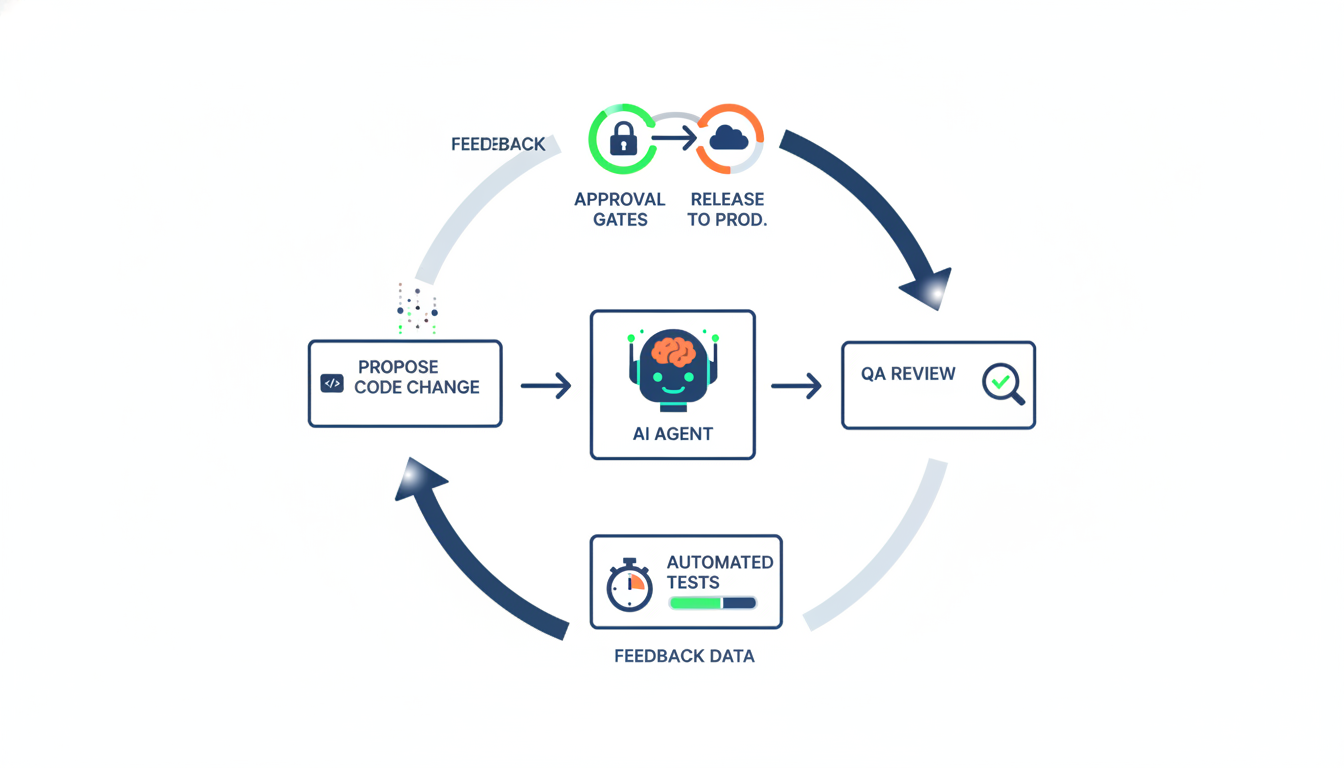
The new QA leader responsibilities for AI governed delivery
Next, QA leadership shifts from managing test execution capacity to managing the rules and evidence that make AI delivery safe. When an agent can open a pull request at 2 a.m. and run a full suite in minutes, the bottleneck becomes clarity: what “good” means, what proof is required, and when a human must step in.
If you do one thing first, make quality expectations readable by both humans and agents. Vague standards like “works on my machine” or “looks good” create silent risk that only shows up after release.
Set guardrails agents can follow reliably
So the QA leader owns guardrails that turn quality into repeatable checks. You are writing the standards and acceptance criteria in a way a developer, a tester, and an agent can apply the same way every time.
Focus your guardrails on:
Quality standards tied to measurable signals (for example: target response time under a set threshold, zero critical accessibility failures)
Acceptance criteria that include edge cases (for example: “user can reset password” plus “rate limit after 5 attempts in 10 minutes”)
A definition of done that is evidence-based (for example: test results attached, rollout plan defined, monitoring added)
Common mistake: writing guardrails as long narrative docs that nobody checks during a PR. Fix: make them checklist-shaped and attach them to the workflow the agent touches, like the PR template and the release gate.
Own verification strategy, not just test cases
That said, “AI ran tests” is not a verification strategy. QA leadership needs a system for deciding what to measure, what to re-run, and what requires human approval, especially when changes are high impact.
A practical verification strategy usually includes:
Evaluation metrics that catch drift (for example: pass rate by component, flaky test rate, escaped defect rate per release)
Regression safety nets (for example: smoke tests on every PR, nightly full regression, and a canary release with monitoring)
Human-in-the-loop approvals for high-risk changes (for example: auth, billing, data migrations, and permission logic)
Works best when your metrics are stable and tracked weekly; it fails when you create dozens of metrics and never act on them. If you’re short on time, skip building new dashboards and start with a simple weekly review of 3 numbers: flaky tests, production incidents, and rollback count.
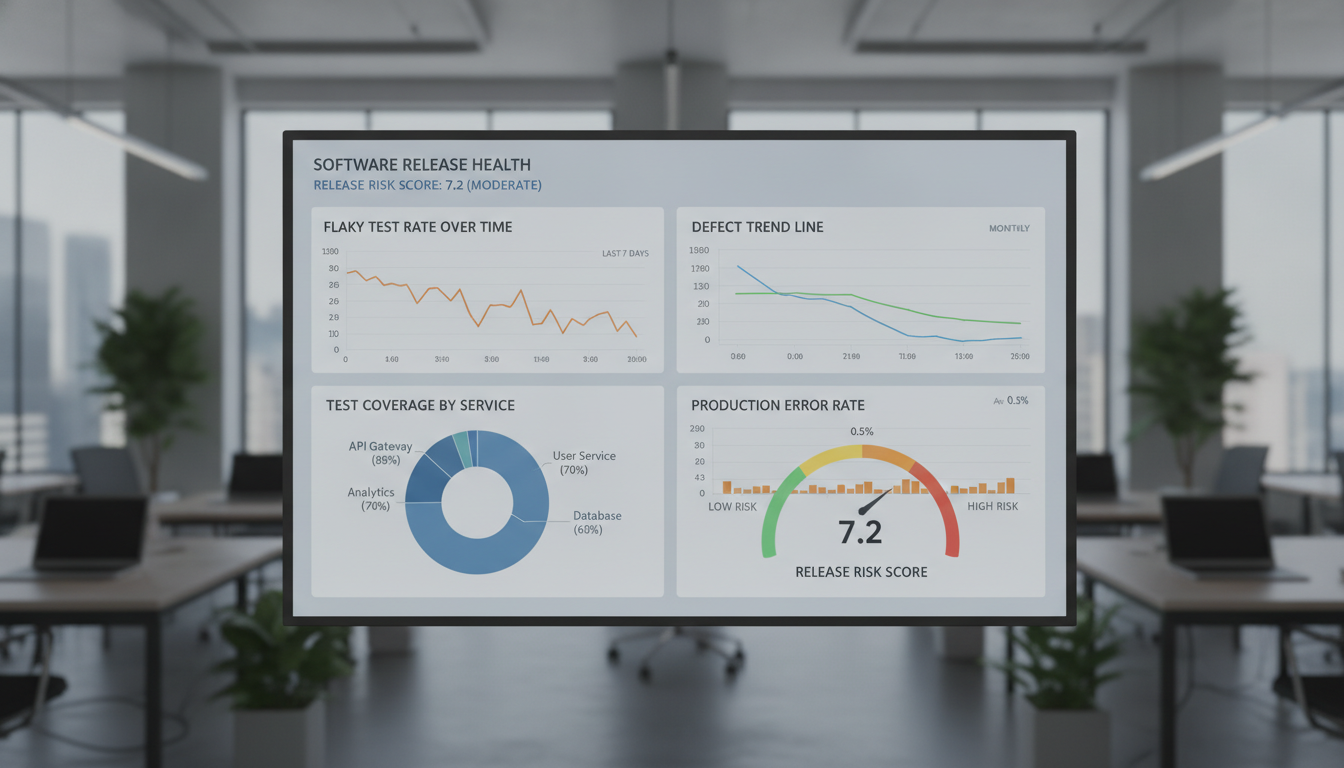
How to operationalize agent ready QA in 90 days
Next, the goal is not to “add AI” to QA. The goal is to make quality predictable when agents can change code faster than humans can review it.
A practical benchmark for the next 90 days is this: you should be able to ship a routine change with a clear, repeatable risk signal in under 30 minutes, and you should be able to explain what blocked a release using a small set of quality indicators, not hunches.
Days 0–30: Build the system that makes quality measurable
So start with the rails that keep agent output from turning into noise. Most teams fail here because they put effort into prompt tweaks while their test environments, data, and signals are unstable.
If you do one thing in the first month, make the system tell you when to trust the build and when to stop. That means a test pyramid that matches how agents work, stable environments, synthetic data you can reset, and observability linked to quality signals.
Focus areas to set up early:
AI-aware test pyramid
Keep fast checks close to the code (linting, type checks, unit tests) so agent-generated changes get feedback in minutes
Reserve slower suites (integration, end-to-end) for the few paths that actually carry release risk
Stable environments
Make test environments reproducible so “works on my machine” does not become “works in my agent run”
Track environment drift (config changes, dependency versions) as a first-class failure cause
Synthetic data
Use resettable synthetic datasets for PII-heavy domains like finance or healthcare
Include “edge case packs” such as nulls, timezones, and extreme values that agents often miss
Observability tied to quality signals
Connect test outcomes to production signals (error rates, latency spikes, rollback frequency)
Make flaky tests visible as a release risk input, not a background annoyance
Days 31–60: Make agent output reviewable, not just fast
That said, even with strong rails, agent changes can be hard to interpret. The tradeoff is simple: agents work best when the task is well-scoped and constraints are explicit, and they fail when requirements are fuzzy or spread across tribal knowledge.
Your job in month two is to make review consistent and cheap. Don’t aim for perfect governance. Aim for a repeatable workflow where humans intervene on the riskiest deltas and let low-risk changes flow.
Team enablement assets that pay off quickly:
Prompt playbooks for common QA work
Examples for generating unit tests for a specific language, adding boundary cases, and writing contract tests for an API change
Guardrails such as “show assumptions first” and “list files changed with reasons”
Review checklists (keep them short)
“What changed” in one paragraph
Risk areas hit (auth, payments, data migrations, performance)
Test evidence provided (new tests, updated tests, run links, failure interpretation)
Rollback plan or feature flag status
Definition of done for agent-assisted changes
When coverage is required, when it is optional
When an engineer must add an integration test vs when a unit test is enough
Common mistake and fix:
Mistake: Reviewing agent changes like a full manual QA pass every time
Fix: Review the risk signal first (flakiness, coverage deltas, defect trend, production error exposure) and then sample deeper only where the signal is weak
Days 61–90: Close the loop with incident learning so agents improve
In practice, the last month is about learning loops. Without them, teams keep repeating the same “agent caused” incidents because the prompts, checklists, and test design never change.
Treat each escaped defect or near miss as training data for your process. You are not training the model; you are training the team’s way of using it.
Build an incident learning loop that fits into weekly work:
After any production issue, capture a 15-minute write-up
What the agent was asked to do
What it changed
What the tests did not cover
What signal you wish you had seen before release
Update one artifact every time
Add a checklist item, add an edge case pack, or add a prompt example
Track improvement with a few metrics
Flaky test rate (should trend down)
Time to decide “ship or stop” (should trend down)
Escaped defect rate for changes labeled “low risk” (should trend down)
If you’re short on time, skip building a big internal portal. Put the playbooks and checklists in the repo next to the code, and require them in pull requests for agent-assisted changes.
Closing remarks
“Speed is useless if you cannot trust what you ship.” That line matters more in an agentic workflow, because the bottleneck moves from writing code to proving it behaves, stays secure, and can be supported when it breaks.
So pick the quality outcome you will guarantee, then work backward. If you do one thing, make the guarantee measurable and repeatable, not a slogan. For many teams, a practical starting point is something like: every change has automated checks for the highest-risk flows, every release has a clear decision record, and every issue can be traced from requirement to test to deployment.
That said, your first change should match your biggest source of risk today. If your incidents come from fast, unreviewed merges, start with policy gates and audit trails. If your risk is silent regressions, start with a small set of critical-path tests that run on every pull request.
Next, avoid a common mistake: trying to score quality with one metric. A single pass rate can look perfect while customers still hit failures in production. Pair at least two signals, for example:
Time to detect a defect and time to recover
Change failure rate plus severity of customer impact
Coverage of critical user journeys plus flaky test rate
In practice, you do not need to fix everything to regain trust. Choose one guarantee you are willing to defend in a release meeting, write down what evidence counts, and remove one source of uncertainty first, whether that is missing traceability, unstable test data, or unclear ownership when an agent changes production code.