
Key Takeaways
When your Playwright project grows faster than your test suite can keep up
Choose a framework shape that agents can extend safely
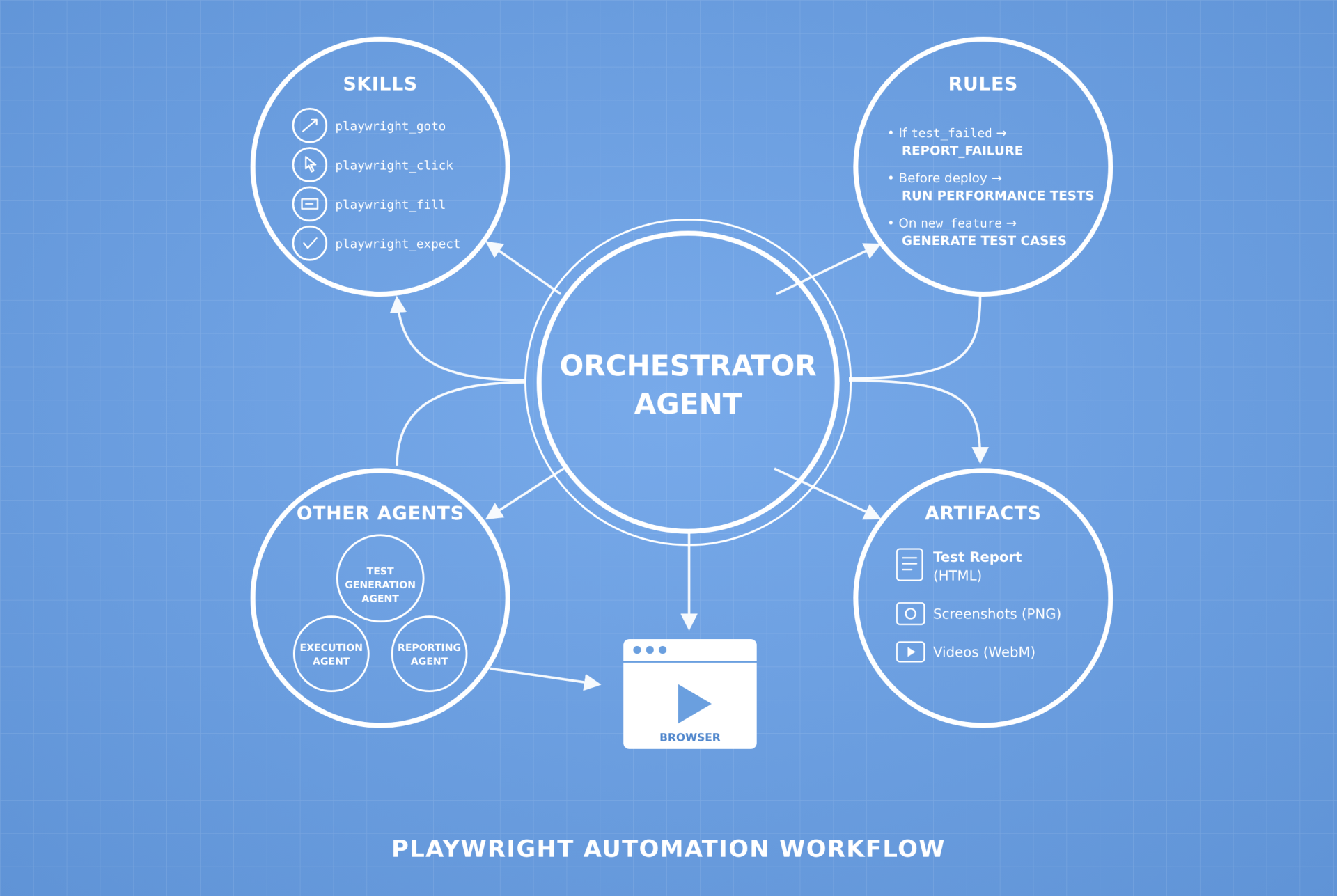
Set up a Playwright project where Claude Code agents help you draft tests faster and keep them updated as the UI changes
Define clear skills and rules so the agent’s output stays consistent, easy to review, and safe to merge
Follow a repeatable workflow that works locally and in CI, and matches what real QA teams do day to day
A common breaking point looks like this: the UI ships changes every week, your Playwright suite keeps growing, and the team starts ignoring failures because too many are “probably flaky.” Once your failure rate creeps above about 5%, the suite stops acting like a safety net and starts acting like background noise.
The result is predictable. QA spends mornings re-running the same specs, developers lose time chasing false alarms, and small UI tweaks (button text, DOM structure, timing) cause a cascade of red builds that do not match real user risk.
So the goal is not “write more tests.” The goal is a structured agentic workflow you can repeat every time the UI changes: scaffold new coverage fast, implement with consistent patterns, then stabilize what you wrote until it is boringly reliable.
If you do one thing, do this: treat flakiness as a build-breaking defect with a short feedback loop, not as “test noise.” Works best when your team can fix tests within 24 to 48 hours of the UI change; fails when flaky failures linger for weeks and become normalized.
Here’s the catch: most flakiness is not randomness, it is ambiguity in the test.
Common causes you can spot in minutes:
Selectors tied to layout or CSS classes instead of stable attributes
Assertions that check “something happened” instead of “the right thing happened”
Tests that click before the UI is actionable (missing an explicit wait for a specific state)
Shared state across tests (reused accounts, leftover data, non-isolated sessions)
A practical fix is to split each new test into three passes: scaffold, implement, stabilize. Your agent can help on all three, but you still decide the acceptance line for “reliable enough” before it lands in main.
Next, assume your agent will write files you did not plan for, at 2am, under time pressure. Your job is to make the “right” change the easiest change by setting a few conventions that never change, even when the app does.
Start with a predictable repo shape and naming rules so new tests land in the right place on the first try. For example, keep specs in one folder, page objects or helpers in another, and test data in a third. If you do one thing, do this: decide exactly where a new spec for “Checkout, guest user, credit card” should live, and what it should be called, before you ask an agent to write it.
Pick conventions agents can follow without guessing:
Repo layout: tests/, pages/ (or fixtures/), data/, utils/, reports/
Naming: checkout.guest.spec.ts, login.admin.spec.ts, cart.smoke.spec.ts
Tagging: @smoke, @regression, @checkout (keep to 1 to 3 tags per test)
Environments: local, staging, prod-like (use feature flags or config, not code edits)
Test data strategy: seeded users (like user_buyer_01), or factory data created via API
Here’s the catch: conventions work best when they are simple and enforced automatically, and they fail when they are only documented in a README. Add guardrails that make “wrong” output noisy.
Define a strict “done” bar for agent output so you do not ship flaky tests. A good definition of done is not “test passes once”, it is “test is explainable, repeatable, and traceable when it fails”.
A practical “done” checklist for each PR (human or agent-created):
Linting and formatting pass with the same command in CI and locally
Tracing is on for failures (and for the first run of new specs) so you can replay
Fixtures are used for login and setup so specs stay short (aim for under 100 to 150 lines)
Selectors are deterministic: prefer getByRole with a stable name, avoid brittle CSS and text fragments
Assertions check outcomes, not timing (avoid waitForTimeout, wait on a visible state or request)
Common mistake: letting the agent “fix” flakiness by adding sleeps. Fix it by requiring deterministic selectors and a trace artifact for every new test, so you can see whether the browser, the network, or test data caused the failure.
Next, make Claude Code predictable by giving it a small set of named agents with clear handoffs. Agentic work breaks down when one agent tries to design, write, review, and debug in the same pass, because mistakes hide until CI.
Start with four core agents and keep their scope tight:
Framework Architect: owns folder structure, fixtures, shared utilities, and page-object boundaries
Test Author: writes new tests and updates existing ones using the agreed patterns
Reviewer: checks readability, selector choices, assertions, and whether the change is commit-ready
Flake Hunter: investigates flaky failures, adds diagnostics, and proposes stability fixes
Also, establish skills and rules that every agent must follow, then require outputs that are ready to commit. If you do one thing, make the selector policy explicit, because most long-term maintenance pain comes from brittle locators.
Use rules like these to keep behavior consistent:
Selector policy: prefer getByRole and accessible names, then getByLabel or getByText; avoid CSS chains and nth() unless there is no stable alternative
Page-object boundaries: page objects expose intent-level actions (for example, addItemToCart("Starter")), not raw locators; tests keep assertions, page objects keep interactions
Commit-ready outputs: every change includes updated tests, any needed fixture updates, and a short note explaining why a selector or wait is necessary
Here's the catch: this works best when your UI has stable accessibility attributes and predictable environments, but it can fail when the app renders random IDs or has non-deterministic data. If you're short on time, skip building new abstractions and instead tighten the selector policy and add diagnostics (trace, screenshot on failure) so the next iteration is faster.
Next, treat every new feature like a small production change: it needs a clear brief, a plan, and a reliability pass before it hits CI. If you do one thing, make the workflow explicit so Claude Code produces tests that match your app’s intent, not just the happy path you happened to see in a single run.
A practical loop looks like this:
Brief: write 5 to 10 lines with user role, entry point, and success criteria (example: “As an admin, I can invite a user, they receive an email, and the user appears in the Members list within 10 seconds”)
Plan: list 3 to 6 checks the test will make, plus the data it needs (accounts, feature flags, seeded records)
Scaffold: create the test file, fixtures, and page objects (or screen helpers) with stable selectors
Implement: add steps and assertions, keeping each test focused on one user journey
Self-review: run locally at least 2 times, verify names, comments, and failure messages read clearly
Stabilize: add traces and targeted retries only where needed, then confirm the test is consistent in CI
Also, reliability comes from guardrails, not hero debugging. Agent-written tests tend to get flaky when they depend on timing, random data, or UI text that changes weekly, so you need rules that catch those patterns early.
Add lightweight guardrails that fit into a pull request and a CI run:
PR checklist
One clear reason for the test to exist (what bug or risk it covers)
Locators prefer data-testid or accessibility roles, not CSS chains
At least one assertion that proves the right page state (not just “no error”)
Local run: 2 passes minimum, plus 1 pass in headed mode for new flows
Flaky-test triage rules
If a failure is non-deterministic, mark it as “quarantine” and fix within a short time window
If the failure is a real product issue, open a bug and link it in the test comment
If the failure is timing-only, replace waitForTimeout with expect(...).toBeVisible() or network-based waits
CI feedback loops
Save traces on failure for the first retry only, to keep artifacts readable
Track top 5 failing specs weekly and assign an owner to reduce repeat failures
If you’re short on time, stabilize the most business-critical flow first (for example: checkout, login, or invitation) and postpone low-risk UI polish tests
Next, keep a simple standard in front of the team when you feel pressure to ship fast: “Quality is never an accident; it is always the result of intelligent effort.” The point is not perfection, it is repeatability: the same UI story should produce the same green run on your machine and in CI.
That said, ask one practical question every sprint: what would change in your delivery speed if every new UI story produced stable tests in the same day. If you do one thing, make it this: treat test creation as part of the story’s definition of done, not something you schedule after the release.
Quick recap:
Write the first passing test while the UI work is still fresh
Keep selectors, fixtures, and helpers consistent so failures are easy to debug
When you are short on time, cover the happy path plus one high-risk edge case
If tests are flaky, fix the root cause before adding more coverage